

TL;DR:
- Regular proactive appliance maintenance can reduce repair costs by up to 50 percent in Monmouth County.
- Environmental factors like humidity, salt air, and hard water necessitate more frequent appliance care than national recommendations.
- Partnering with local, knowledgeable service providers ensures quicker, more effective repairs and long-term savings.
Most homeowners in Monmouth County think appliance care means wiping down the stovetop or vacuuming the fridge coils once a year when something smells off. That mindset is costing you money. Routine maintenance cuts repair costs by 50% over five years, and coil cleaning alone improves refrigerator efficiency by 25%. Integrated appliance care is not a luxury or a branded service package. It is a structured, proactive approach that keeps every appliance in your home or business running longer, cheaper, and more reliably. This article will define what it means, explain why Monmouth County’s environment demands a tailored routine, and give you clear steps to start today.
Table of Contents
- What is integrated appliance care?
- Why Monmouth County needs a unique appliance care approach
- Key steps for effective integrated appliance care
- Choosing the right local appliance care provider
- A smarter way to think about appliance care in Monmouth County
- Your next step: Protect your appliances and your wallet
- Frequently asked questions
Key Takeaways
| Point | Details |
|---|---|
| Integrated care defined | It means combining cleaning, routine checks, and smart updates for all appliances. |
| Local routine matters | Monmouth County’s humidity and water quality require more frequent care for long-lasting appliances. |
| Save with prevention | Proactive maintenance can cut repair costs in half and boost appliance efficiency. |
| Choose local experts | Local providers resolve issues faster and understand climate-specific needs. |
What is integrated appliance care?
The term sounds technical, but the concept is straightforward. Appliance care refers to preventive maintenance practices that combine physical cleaning, software updates for smart appliances, and routine inspections. It is not a single product or service you buy. It is a mindset and a schedule.
Think of it like dental care. You do not wait for a toothache to start brushing. You brush daily, floss regularly, and see a dentist twice a year. Integrated appliance care works the same way. You clean, inspect, update, and seal on a regular schedule so small problems never become expensive emergencies.
Here are the core tasks that make up a complete integrated care routine:
- Cleaning coils and filters on refrigerators, dryers, and HVAC-connected appliances
- Descaling kettles, dishwashers, and washing machines to remove mineral buildup
- Updating firmware on smart appliances like connected ovens and refrigerators
- Checking door seals and cabinet gaskets to prevent energy loss
- Inspecting vents and drainage lines to avoid blockages and water damage
- Lubricating moving parts on washers and dryers to reduce wear
One important distinction worth knowing: integrated appliances (built-in units like panel-ready dishwashers or under-counter fridges) have different care needs than freestanding models. Integrated appliances require specialized access for cleaning and repair because their components are tucked behind cabinetry. You often need to remove panels or follow manufacturer-specific steps just to reach the coils or drain pump. Freestanding appliances are more accessible, but that does not mean they need less attention.
Key insight: Proper NJ appliance care tips show that homeowners who follow a structured maintenance routine spend significantly less on emergency repairs than those who only call a technician when something breaks.
Understanding the importance of regular maintenance is the first step. Applying it consistently is what separates homeowners who replace appliances every seven years from those who get fifteen or more years out of the same machines.
Why Monmouth County needs a unique appliance care approach
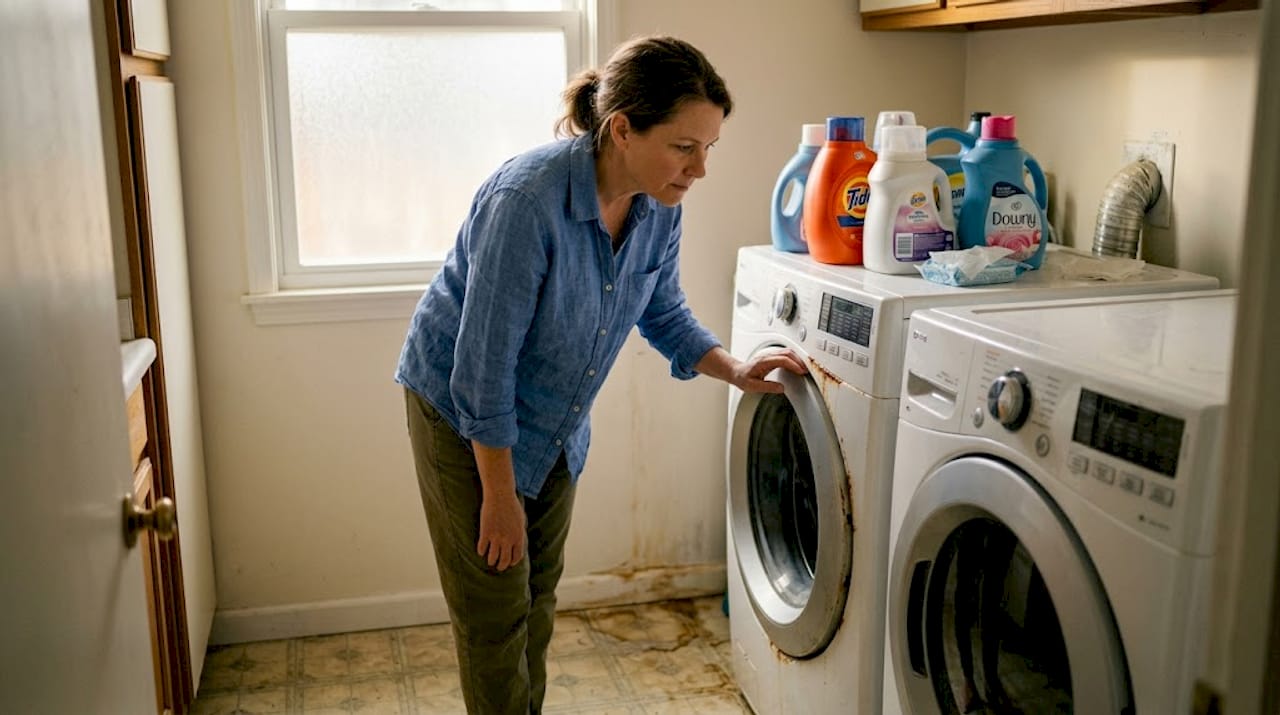
Generic maintenance advice written for homeowners in Phoenix or Chicago does not fully apply here. Monmouth County sits along the Jersey Shore, which means your appliances deal with humidity, salt air, and hard water every single day. Those three factors accelerate corrosion, clog filters faster, and shorten appliance lifespans faster than in drier, inland regions.
Salt air is particularly aggressive. It speeds up rust on metal components inside washers, dryers, and refrigerators. Humidity causes rubber seals to degrade faster and promotes mold growth in dishwasher interiors and washing machine drums. Hard water leaves calcium and magnesium deposits in dishwashers, coffee makers, and water-connected appliances, reducing efficiency and eventually causing failures.
Here is how Monmouth County maintenance intervals compare to national recommendations:
| Appliance | National recommendation | Monmouth County recommendation |
|---|---|---|
| Refrigerator coil cleaning | Every 6 months | Every 3 to 4 months |
| Dishwasher descaling | Every 3 months | Monthly |
| Dryer vent inspection | Annually | Every 8 months |
| Washing machine drum cleaning | Every 2 months | Monthly |
| Door seal inspection | Every 6 months | Every 3 months |
Stat worth noting: Cleaning refrigerator coils on the Monmouth schedule improves efficiency by up to 25%, which shows up directly on your energy bill.
Monthly descaling is recommended for Monmouth County homes due to the area’s hard water. Skipping this step is one of the most common reasons dishwashers and washing machines fail prematurely in this region.
The Monmouth repair savings guide breaks down exactly how much you can save by adjusting your schedule to match local conditions. It is a practical resource that goes beyond generic advice.
Pro Tip: Set calendar reminders on your phone for every 3 to 4 months labeled by appliance. Treat them like bill payments. Missing one or two is fine, but consistent gaps add up fast in a coastal climate like Monmouth County’s.
For more region-specific guidance, the Monmouth appliance tips resource covers common local failure points and how to address them before they become repair calls.
Key steps for effective integrated appliance care
Knowing you need a routine is one thing. Having a clear, simple plan is another. Here is a quarterly care routine that works for most Monmouth County households and small businesses:
- Clean refrigerator coils. Pull the fridge away from the wall or remove the bottom grille. Use a coil brush and vacuum to remove dust and debris. This one step protects the compressor and keeps energy costs down.
- Inspect and clean dryer vents. Lint buildup is a fire hazard and reduces drying efficiency. Check the exterior vent cap for blockages while you are at it.
- Descale water-connected appliances. Run a descaling cycle on your dishwasher and washing machine. Use a manufacturer-approved descaler, not just vinegar, for best results.
- Check door seals on fridges and ovens. A worn gasket lets cold or heat escape, forcing the appliance to work harder. Replace seals that feel stiff, cracked, or loose.
- Update smart appliance firmware. Check the app or control panel for available updates. Manufacturers regularly push fixes that improve performance and energy efficiency.
- Inspect drainage lines and filters. Dishwashers and washing machines have filters that trap debris. Clean them quarterly to prevent slow draining and odors.
Mechanics include cleaning coils and filters, checking seals, running software updates, and descaling as the foundation of any solid care routine. These steps are not complicated, but they do require consistency.
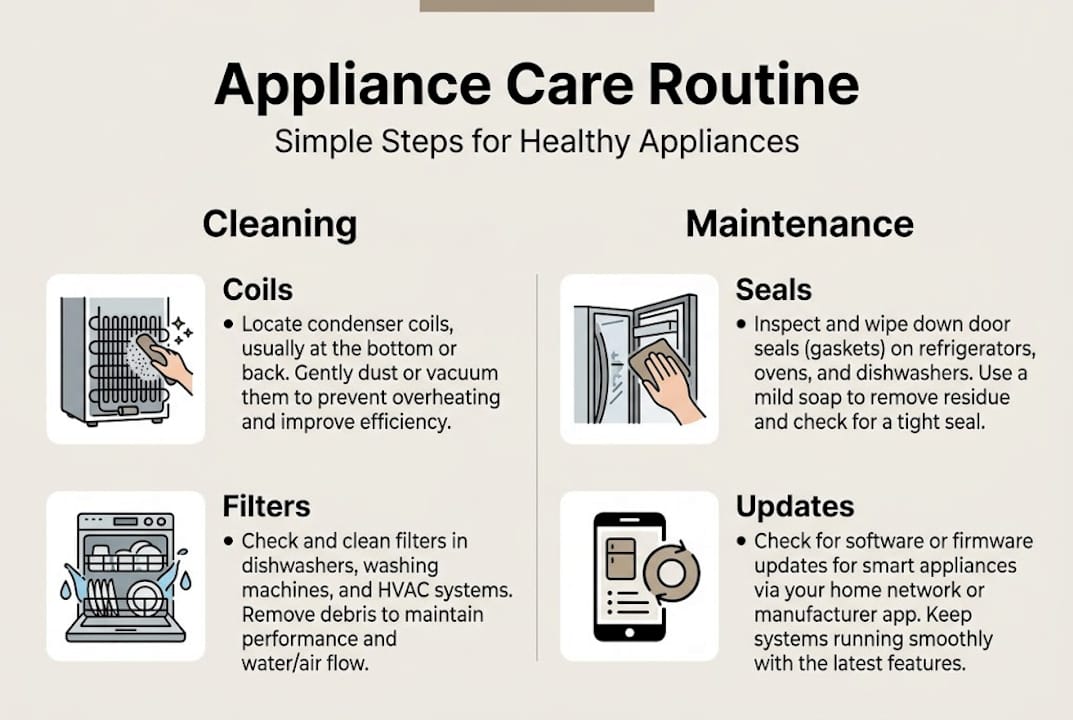
The appliance maintenance checklist on our site gives you a printable version of this routine, organized by appliance and season. Pair it with the DIY maintenance tips guide for step-by-step instructions on each task.
Pro Tip: Keep a simple log for each appliance, either a notes app entry or a sticky note on the inside of a cabinet door. Write down the date of each service task. When something breaks, a technician can use that log to diagnose problems faster and more accurately.
Choosing the right local appliance care provider
Even the most diligent homeowner will eventually need professional help. Knowing who to call before something breaks is smarter than searching in a panic at 9 PM when your fridge stops cooling.
Here is how local Monmouth County providers compare to national service chains:
| Factor | Local Monmouth provider | National service chain |
|---|---|---|
| Response time | 2 to 4 hours | 3 to 5 business days |
| First-visit fix rate | 85% same-visit fixes | Varies widely |
| Knowledge of local conditions | High | Low |
| Parts availability | Often stocked locally | Shipped, adds delays |
| Pricing transparency | Upfront quotes common | Variable |
Worth knowing: Local providers resolve 85% of appliance repairs on the first visit, compared to the multiple-visit model common with national chains that ship parts from central warehouses.
When you are evaluating a provider, here is what to look for:
- State license and insurance verified before any work begins
- OEM (original equipment manufacturer) parts used for repairs, not generic substitutes
- Same-day or next-day availability for urgent situations
- Verified local reviews on Google or Yelp from Monmouth County customers
- Brand authorization for your specific appliances (Samsung, LG, Whirlpool, etc.)
Expert Appliance, Mr. Appliance, and Advanced Appliance Repair are among the recommended local providers in the Monmouth area. Each offers different strengths, so matching your needs to the right provider matters.
For urgent situations, fast local repairs are available with same-day scheduling across Monmouth County towns including Marlboro, Freehold, and Manalapan.
Pro Tip: Choose providers who are authorized service agents for your appliance brands. They have access to manufacturer training, updated repair protocols, and genuine parts that generic shops may not carry.
A smarter way to think about appliance care in Monmouth County
Here is an uncomfortable truth we have learned from decades of serving Monmouth County homeowners: most people treat appliance care the same way they treat car oil changes before they know better. They wait until the warning light comes on. By then, the damage is already done.
The real cost is not the repair bill. It is the compounding effect of deferred maintenance. A $40 descaling treatment skipped three times in a row becomes a $600 dishwasher pump replacement. A coil cleaning ignored for two years becomes a $900 compressor repair.
What national guides consistently miss is the Monmouth factor. Salt, humidity, and hard water are not just inconveniences. They are accelerants. They turn a six-month maintenance window into a three-month one. Generic advice built for average American conditions leaves local homeowners underprotected.
The smarter approach is to treat appliance care as a data-driven routine, not a reaction. Track service dates, notice patterns, and adjust your schedule based on how your specific appliances perform in your specific home. The appliance repair benefits go beyond cost savings. Well-maintained appliances run quieter, use less energy, and last years longer. That is a real quality-of-life difference.
Proactive care, even with occasional professional checkups factored in, costs far less than reactive repair. That math holds true every single time.
Your next step: Protect your appliances and your wallet
You now have a clear picture of what integrated appliance care means and why it matters more in Monmouth County than anywhere else. Putting that knowledge to work is the next move.
Expert Appliance Repair has been serving Monmouth County homeowners and small businesses since 1988. We offer same-day service, upfront pricing, and maintenance plans built around local conditions. Whether you need a one-time checkup or ongoing support, our team is ready. Explore maintenance tips to prevent repairs, check out current repair service discounts, or schedule same day appliance service right now. Proactive care today prevents expensive surprises tomorrow.
Frequently asked questions
Is ‘Integrated Appliance Care’ a specific service or just a set of practices?
It refers to a set of best practices that combine cleaning, maintenance, and updates, not a distinct branded service. Appliance care means proactive routines, not a product you purchase from any single company.
How often should I service my appliances in Monmouth County?
You should clean refrigerator coils every 3 to 4 months, descale water-connected appliances monthly, and inspect dryer vents every 8 months. Monmouth County needs more frequent maintenance schedules than national averages due to local climate conditions.
Does preventive maintenance really lower repair costs?
Yes. Routine maintenance cuts repair costs by 50% over five years, making it one of the highest-return habits a homeowner can build.
What makes Monmouth County’s appliance care different?
Local humidity, salt air, and hard water require more frequent and targeted maintenance than most other regions. Monmouth climate demands more frequent checks because these environmental factors accelerate corrosion, seal degradation, and mineral buildup faster than inland or drier climates.